-
I Give My Book To R.L. Stine!
I unfortunately didn’t have a stall at the WV Book Festival yesterday. That shows me for not having my application in before (checks notes) April 1. (?) However, it did allow me the opportunity to get a book signed by the one and only R.L. Stine, author of the Goosebumps books!
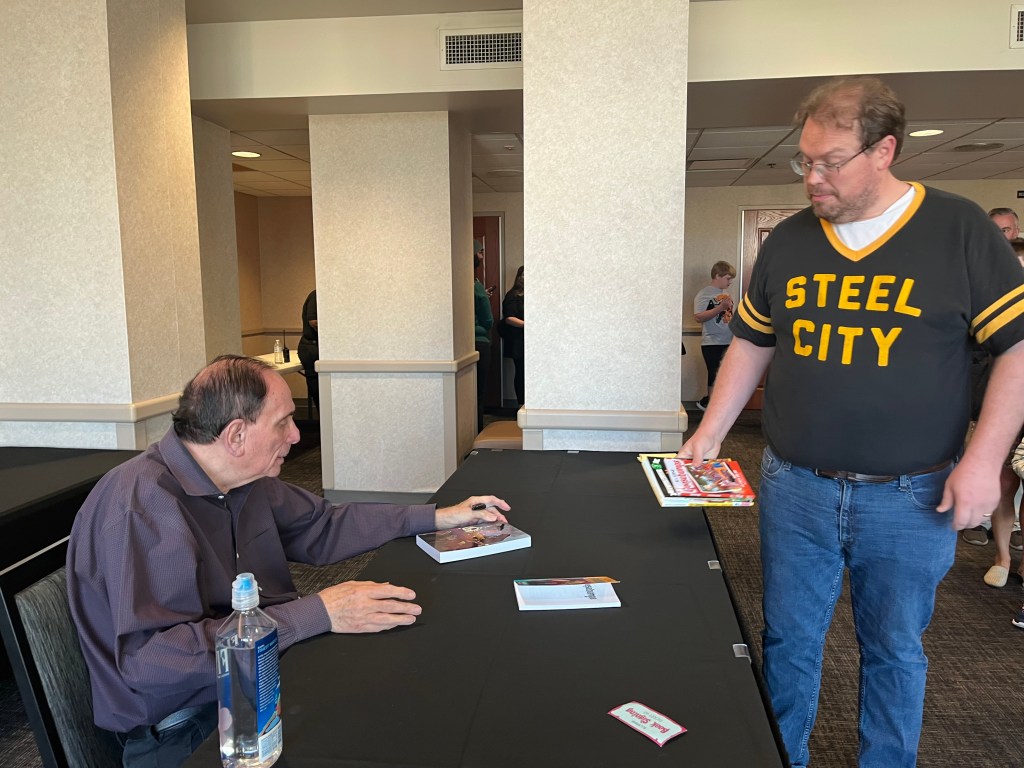
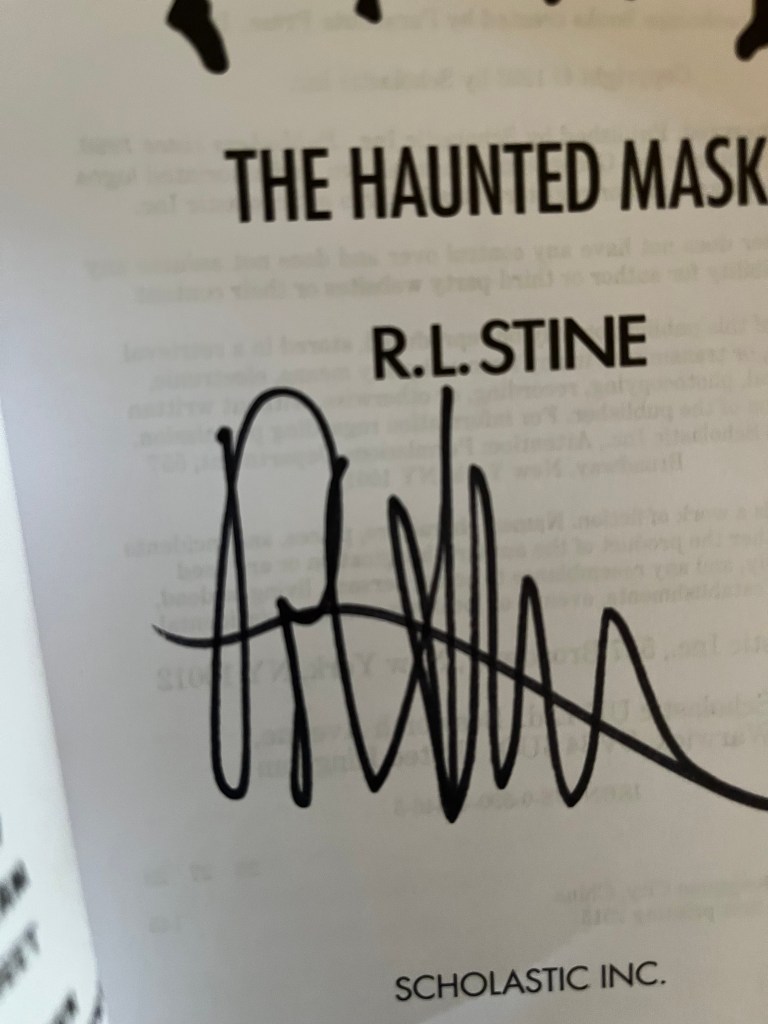
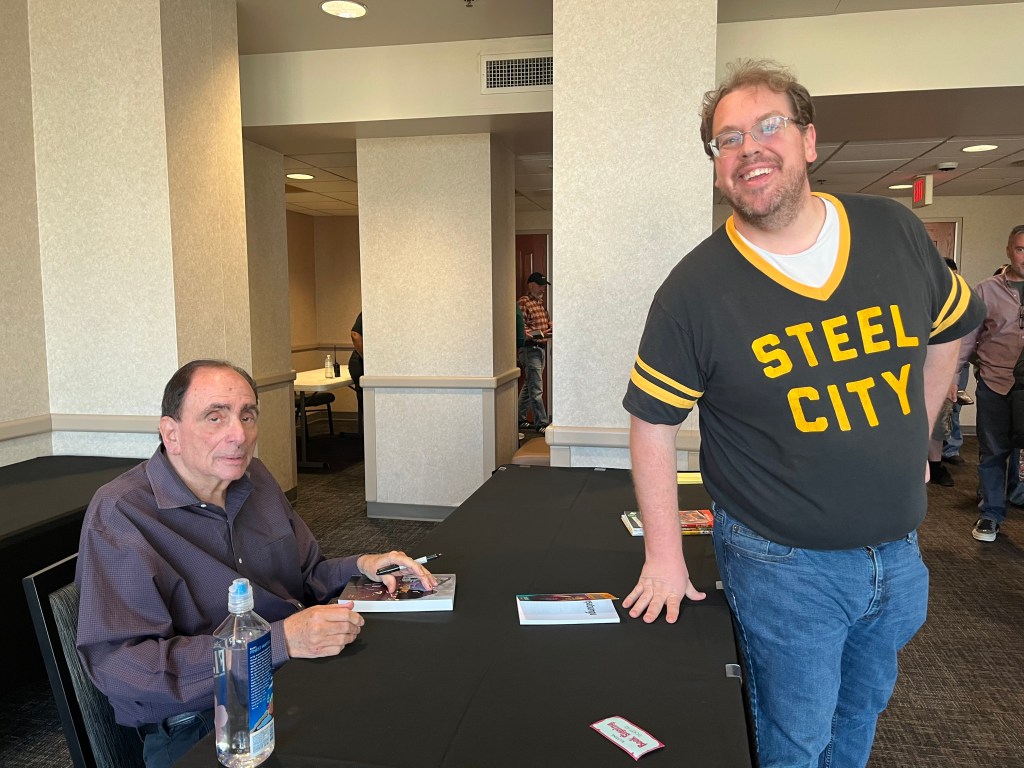
He signed a copy of the Haunted Mask for me, and I gave him a free copy of Christmas in Pandemonium. He said he’d read it on the plane back. Gosh, do you think he’ll actually read it? It’s the sort of thing that I stay up thinking about at night.
As for Pandemonium itself, my publisher and I are working on edits to the second book while I draft the third one. I just got to 70,000 words on the rough draft. Man, I feel animated! I ought to get Tim Jacobus to draw me!
-
It is Now Official Spooky Season
Okay, at risk of being a hypocrite, I am now willing to say it is okay to begin Halloween Season. I changed my pitch for Christmas in Pandemonium yesterday. By the way, it has been over one year since the book came out. I am happy with how it is doing. But I wanted to announce this since I’ve complained earlier about people celebrating Halloween too early. I figure that since this week bleeds into October. It is okay to start. Happy Halloween everyone. Check out Christmas in Pandemonium.
Christmas in Pandemonium eBookI’m looking forward to gorging myself on Halloween candy, watching scary movies, and listening to old Halloween specials from the 1980s while putting off work.
-
Pandemonium: Death and Ashes Accepted for Publication!
Good news everyone! Pandemonium: Death and Ashes, my long-anticipated sequel to Christmas in Pandemonium, has been accepted for publication by I Ain’t Your Marionette Press! They are now in the review and editing stage, but my publishers tell me that they do not plan any major changes to the plot, so right now, I’m going to consider that a win. Given that my creative vision is coming through, I fell relieved.
I also fell I can start drafting the third book: Easter in Pandemonium. I’m planning on starting that tomorrow. Or hell, maybe tonight, depending on what my family life allows. In any event, Easter in Pandemonium is my next project now that I’ve finished drafting the Adventures of Bruce Manley and Pandemonium: Death and Ashes has been accepted. Wish me luck!
-
A Half-Hearted Apology for Patriots Day
Apparently, I must make an apology for my last post. I lack the technical expertise to delete my last post or delete it, so I must own up to it. I cannot pretend it did not happen. I made fun of the idea of Patriots Day in my last post, unaware that Patriots Day is now the official title that September 11 now has. No, no one pointed this out to me. I learned this through reading as we approached the 25th anniversary of that terrible day. May as well own up to my faux paus.
And let me state my opinion: Patriot Day is a fucking terrible name for September 11. Patriot Day is exactly the kind of name you make fun of, which is why I made fun of it. It’s the kind of name you give to a holiday where you’re trying to sell people shit you couldn’t sell on July 4th or Memorial Day and you don’t expect to sell on Veterans Day. It’s not the kind of holiday that you expect to mean something, which September 11th should be, if you plan to make it a holiday. Thousands of innocent people died that day. You can cut all the subsequent discussion of U.S. foreign policy, which those people had no role in deciding, either prior to that event and obviously no role going forward. Thousands of innocent people died. That carries a certain weight, and the term “Patriot Day” doesn’t hold that weight. That’s the Barney the Dinosaur version of history.
What should it be called? I don’t know. Maybe 9/11? I’m a millennial. This was the Kennedy Assassination for my generation. We all used 9/11, and we all knew what we were talking about when we said that. That should be sufficient. That phrase carries sufficient moral weight. Patriot Day sounds like something that was declared by the federal government, which it probably was. I haven’t bothered to look it up. That tells you something.
Patriotism means loving your country more than you love yourself. A lot of people have claimed the title since 9/11, but few have earned it. That’s a high bar. There are a lot more nationalists. Nationalism means loving your country more than some other country, which is a low bar.
So, this 9/11, which is what I am calling it, don’t call yourself a patriot. Try your best to earn the title. Let other people call you that. Don’t celebrate Patriot Day. Have a solemn 9/11.
-
Rejected Holidays
Happy Labor Day everyone! I always appreciate getting a day off, regardless of the occasion. Labor Day exists to honor the contributions of the American Labor movement to our society. It reminds me of that time my boss would only give us Labor Day off if we also agreed to celebrate Management Day, where we all had to work 14-hours for free on a Saturday. Needless to say, we didn’t take him up on that. The readers of this blog know I can get up on my high horse about holidays, holiday creep, and the need for more holidays. I thought I would do a piece on other rejected holidays, all of which I just made up. Just like Management Day!
In-Laws Day–In an attempt to follow up on the success of Father’s Day and Mother’s Day, the greeting card companies attempted to create a day in October to appreciate your mother-in-law and father-in-law. However, the holiday failed to get off the ground as the awkward, standoffish, and distant emotions expressed in those cards didn’t exactly fly off the shelves. Few people would buy a card expressing respect for how clean your house is or how glad you are that they taught their daughter how to cook. Best to just send Christmas cards with the grandkids in them.
Poison Ivy Appreciation Day–Botanists, seeing the success of Arbor Day, decided to give a different kind of plant some positive press, arguing that far from being a pest to be wiped out, Poison Ivy actually served an important role in the ecosystem. They did caution that this particular part of the flora is best appreciated at a distance, which most people had no problem with. Unfortunately, most people honored the holiday at a distance as well.
Patriot Day–In a blatant attempt to stretch out the summer patriotic season, various retail stores petition Congress to create Patriot Day in late August, giving Wal-Mart and Target the opportunity to offload all of their surplus red, white, and blue merchandise left over from Memorial Day and the 4th of July. Congress gets tripped up on what exactly this day is supposed to be celebrating, as the petitioners can’t identify any war America won that it’s supposed to commemorate, and we already have two days to celebrate veterans. The retail store representatives shrug their shoulders and just keep waving flags. “You don’t hate America, do you?” Congress goes along with it until someone brings up what giving everyone the day off would cost the American economy, leading an even bigger army of lobbyists to storm D.C. to oppose it.
Saint Stephen’s Day–Technically still a holiday, scheduled right after Christmas on December 26. However, Christmas has overshadowed this holiday, like someone who has their birthday around the holiday season. That, and the church stopped promoting it. St. Stephen, you see, was stoned to death, and whenever the church tried to teach the story of his martyrdom, the priest would always get comments like “Move it to April 20” and “I wonder if Phish would be interested in playing at the Mass.” Then they found out how some people were privately celebrating the holiday, and that was that.
Robert E. Lee Day–Several southern states, when forced to celebrate Martin Luther King Day, insisted on doing so only if they simultaneously celebrated Robert E. Lee Day. Thankfully, this is a satirical piece…no, wait, this is real. Mississippi and Alabama still do this.
-
Now Querying Live in the Dream to Independent Publishers
Hello, small announcement, but I just send out the first three queries for Live in the Dream to independent publishers. I got no response from literary agents, so I’m moving down to the next peg. A little disappointing, but that’s the business. Let’s see if we get any bites at this level. Wish me luck.
-
WHAT DO I DO IF MY BOOK ISN’T LIKE ANYTHING PUBLISHED RECENTLY?
I’ve been working on a new project: the Adventures of Bruce Manley. It’s basically a story about a rich loser. No, really, it’s about a trillionaire heir in the near future who spends all of his time and money playing a super-advanced video game. He legally changes his name to Bruce Manley, which is his avatar’s name, right before his attorney has him sign some legal papers, forcing his attorney to redo them. Bruce gets kidnapped by rival players in the game because he dominates the game so much, making it impossible for these rivals to make money off their brand. Bruce, being a moron, tries to escape and fails, but gets bailed out anyway because the in-game economy starts to collapse without him spending obscene amounts of money on it.
I’d say more, but I don’t want to give the plot away. Basically, it’s a story from the perspective of a lazy, unlikeable jerk. The problem I am having is that to sell books to literary agents or indie publishers, you usually have to come up with a list of similar books, ideally from within the last 10 years. What I do is come up with a book, write the book, and then search for books that are similar. My problem with this book is that I can’t find any. I can’t find any books from the last 10 years that are like The Adventures of Bruce Manley.
Believe it or not, there really aren’t that many books from the perspective of the bad guy. I mean a genuine bad guy. There are books like Starter Villain or How to Become the Dark Lord or Die Trying, but these books aren’t really about actual bad guys. These are about decent guys playing roles with the label “bad guy.” The other avenue of “similar” books is LitRPG books like Dungeon Crawler Carl, but having read some of those books, I know a lot of those books get into the granular details of experience points, mana points, power levels, and bosses. Bruce Manley is not like any of those. I’ve also learned, having read a lot of LitRPG recently, that outside of Dungeon Crawler Carl, I’m actually not a big fan of LitRPG.
Bruce Manley has literary inspirations. It’s a story from the perspective of the villain. Think American Psycho and The Screwtape Letters. The problem is that neither of those books is recent. This is kind of a problem for me in selling the book. Any suggestions?
-
Are Competent Villains Realistic?
A few weeks ago, I asked what makes a good protagonist. Today, I ask what makes a good villain. This has come up as I’ve had my next project put through the ringer of beta readers. Their main complaint is that my villains are too incompetent, and so are government officials generally. My response is that this is a feature not a bug. Writers are constantly asking ourselves whether our characters and plots are realistic. By that measurement, my villains and government officials aren’t incompetent enough.
I can see where the criticism comes from. It’s not atypical for pieces of classic literature and pop culture to feature hypercompetent protagonists face off against hypercompetent antagonists. Sherlock Holmes against Professor Moriarty. Captain Kirk versus Khan Noonien-Singh. Batman has spent the last 86 years punching the Joker in the face, and for some reason the public never gets tired of it. The problem is that the average bad guy is not like Prof. Moriarty, either the novel version or the holodeck version. Most crooks are more like the guy who shows up to the police station to claim his stolen methamphetamine. The idea of the criminal mastermind is a myth created by detective novels and gangster movies. Contrary to a popular myth, serial killers do not have a higher IQ than the general population. The most common frauds are just repeats of the same scams pulled off from time immemorial, like Ponzi schemes and Pyramid schemes. Bernie Madoff didn’t do anything new.
The reason for this is pretty simple: people normally get involved in crime to make money. Nobody sells drugs out of the kindness of their hearts. If you are a hypercompetent individual, there are better ways to make money in our society than getting involved in crime, which could get you imprisoned or shot. That’s why all the intelligent sociopaths in America are in corporate boardrooms, not Riker’s island.
But let’s not limit this to criminals. Evil governments are pretty incompetent as well. Hitler’s military misadventures are almost as infamous as his crimes against humanity. The Austrian painter directed the Third Reich’s military empire like a Wagnerian opera: strong emphasis on emotion, little on reason. On the other extreme, communist governments are well known for creating man-made famines that starve millions due to their agricultural and economic mismanagement. The Berlin Wall fell because a bureaucrat misread an announcement by the party concerning travel guidelines. Oops.
Why limit that to evil governments? As someone who works in state government, I can tell you that governments of all stripes make mistakes all the time. The Tax Division of the state government I work for recently had to admit they’d been mistakenly paying out hundreds of thousands of dollars in tax refunds to companies for a gasoline tax those companies never actually paid. I don’t want to throw anyone under the bus here. I’ve made enough mistakes as an attorney that part of me is surprised I haven’t been sued.
Competence is rare. Incompetence is the norm. Most of us are incompetent at most things in life that require any kind of skill, largely because we’ve never tried to do them. Building competence in a field generally requires years of practice and it helps to have a mentor. Assuming that most people should be competent at most things is a fantasy, and it is actually a harmful fantasy because it leads to a lot of false beliefs when something goes wrong. When a terrorist attack happens, people have problems believing the government could have just failed to stop it, and people start coming up with conspiracy theories about how they were in on it. Companies underinvest in training because they think it’s unnecessary. People are rude to waitresses when their food is slow. After all, what’s their excuse? It’s easy!
When it comes to writing, you get a lot of complaints from beta readers for having incompetent villains in your books. They aren’t comparing your villains to actual real world villains. They are comparing your villains to great literary villains, cooked up specifically to raise tensions and raise the stakes. What I try to do is give people a little of that: create one villain who is competent, but this guy should constantly be asking why he is surrounded by imbeciles and maybe he should be having second thoughts as to why he is here. Furthermore, when someone actually is competent at something, there should be an explanation for it, either natural talent, or years of practice, or some mentorship relationship in the background. Incompetence is normal. Competence requires an explanation.
-
My Interview with Awesome Gang Books
I’ve got another interview up with Awesome Gang Books. Check it out!
https://awesomegang.com/?p=1184411 -
My Interview with GoodLife Bookstore
Hey everyone! I’ve got a new interview up about Christmas in Pandemonium with GoodLife Bookstore. Check it out on YouTube here!
Maybe you are an Apple Podcast guy:
Also, I’ve got a written interview with BookGoodies up, available here:
http://bookgoodies.com/?p=452263
-
Subscribe
Subscribed
Have a WordPress.com account? Log in now.

