-
A Brief History of the Island and Town of Pandemonium Part II
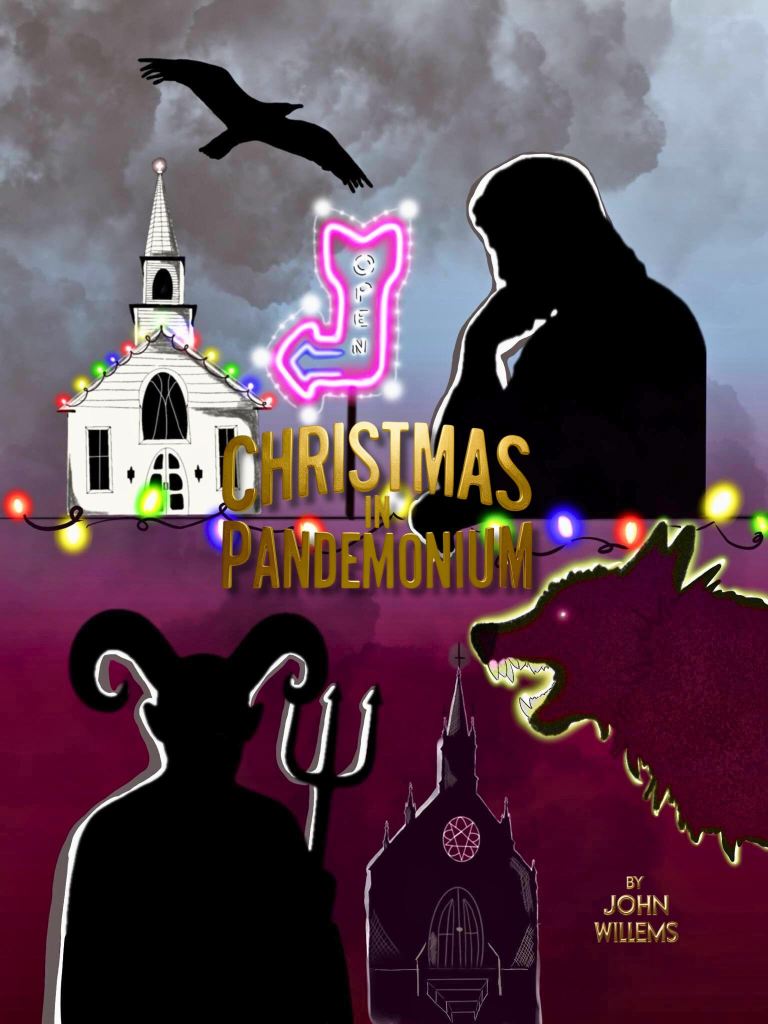
We are back with a Brief History of the Island and Town of Pandemonium, Part II, just as we have finalized the draft and cover of the novel.
***
Benjamin Franklin, one of our country’s illustrious founders, is known to have said “We shall all hang together, or we shall all hang separately.” The sentiment did not originate with him, but with anyone in a similar desperate situation, which the Witches and the Strangers now found themselves in. In this moment, Miller forgot his newly discovered piety and turned to Cramner, who was apparently thinking the same thing. As enemies, they were outnumbered and likely to die, but as allies they stood a chance. Miller spoke first, stating that his earlier words concerning the passage “thou shall not allow a witch to live” may have been overly hasty. Cramner apologized for the sacrifice on the Charon, chalking it up to too much enthusiasm in his congregation to begin their new lives in America. Cramner offered to let the Strangers remain in Pandemonium, provided they assisted with the defense of the island. Miller found that offer most attractive as both he and his crew were wanted by the law elsewhere but insisted that Cramner would have to agree to cease and desist any more acts of human sacrifice. Cramner did not like the condition but did not see an alternative. Recognizing their common plight, the Old Heretic and the Drunkard “shook on it” a second time and proceeded to form an alliance for their own survival. Captain Miller had within the last 24 hours founded a religion and then made a bargain with the Devil.Working together, the Strangers and the Witches successfully rebuffed the Stono attack and then pursued the Stono to the mainland where the chief and the remainder of his forces were slaughtered. The settlers then moved onto the Indian village on the mainland and proceeded to do unto the Stono as the Stono had threatened to do unto them. Having killed all the men (including all boys over the age of 10), the Strangers and Witches carried off the women and burned the village to the ground.[1] Back at Pandemonium, Cramner agreed that because the Strangers, unlike the Witches, had not brought women with them on the journey, the Stono women would be given to the Strangers as wives.[2]
It is one thing to make a deal in haste, quite another to fully negotiate the terms from a position of relative ease. Two months after the alliance was made, the Old Heretic and the Drunkard “shook on it” a third time, but this time they had the foresight to write the terms of the deal down in greater detail. First, the island would be bisected in two by a line agreed to by both parties with the Strangers receiving the North end of the island and the Witches receiving the south end. Both the Witches and the Strangers agreed to stay on their side of the line. That being said, if they were to live together like this, they would have to form a common government, or at least a place to meet in order to deal with future issues. A common meeting hall was established on the exact center of the island with two entrances, one on the Stranger side of the line and the other on the Witch side of the line. A council of six people would be elected, three from each side, and the town would be governed by two different mayors, each one responsible for governing the town on their respective side of the line. The Strangers promised not to report the Witches to any Christian Kingdom or Empire, and the Witches in return agreed reluctantly to give up any practice of human sacrifice.[3] The Strangers also wanted it written down that not only were the Witches not allowed on the Stranger part of the island, but neither was Satan himself allowed. Cranmer, a fallen Anglican priest who had been educated in theology, was amused by this request and stated that perhaps the Witches should ask that God be disallowed from coming onto the Witches’ side of the island. The Strangers discussed it among themselves and to Cranmer’s amazement responded that they found those terms acceptable. Those famous provisions were incorporated into the Bargain of Pandemonium, and though it has been amended over time, that charter remains the basis of our town’s government.[4]
Both parties took this social contract seriously and held up their end of it. When the Crown established the royal colony of South Carolina a few years later, the Strangers did not go running to the local governor to turn the Witches in. This might partly be to do with the price on their own heads, as Miller and his crew had been wanted on smuggling charges for several years. Covered in fog, the island of Pandemonium often went unnoticed by English settlers. When it was necessary to do business with the royal governor, the governing council would vote to appoint a representative who would represent both communities, swearing to reveal none of the secrets about the religious practices in Pandemonium or its founding.
The Witches voluntarily gave up the practice of human sacrifice. Cramner began a religious reform movement within the cult whereby the sacrifice of a human being was replaced by the ritual sacrifice of a goat. Many Witches voiced their concern that without a truly diabolic sacrifice of human life, that their connection to the Evil One would fade, and with it their powers.[5] However, this reform was necessary to protect the deal in place making the town a possibility, and the prohibition on human sacrifice has been honored by Witches to this day, with one notable exception. [6]
The Strangers had their own religious reforms to attend to, as a church can rarely survive with a liturgy depending on a single verse read by a barely literate seaman with no theological training heavily influenced by alcohol. The Strangers disassembled the Charon and used the hull to build their original church on the very ground where they had killed the Stono princess. The Stranger Church[7] also had a cave underneath it, where the bones of the Stono princess were kept. It eventually became a stone crypt once one of the Strangers learned stone masonry. Guilt marked the church’s foundation from the beginning. Miller placed the Bloody Book at the back of the Church’s nave, where it remains today, now under glass. The Drunkard appointed himself as both pastor and mayor, the concept of separation of church and state and that time just developing and proceeded to start leading a service made up mostly of songs and sermons centered on how disgusting and devious the Witches were, despite just having made a permanent alliance with them. Far from repenting, Miller carved the verse “thou shalt not suffer a witch to live” on the arch above the church’s entrance. However, Miller also warned the Strangers to keep the peace, a point he made in a ceremony whereby he took the as ashes of the Stono princess’s cremated body and forced his congregation to drink said ashes with water “so the sin would remain with them.”[8] This contradiction lies at the heart of the Strangers’ faith, and like most mysteries at the heart of religion, the question is not so much unanswered but answered a thousand times over in a way that is unsatisfactory to all involved.
After the Drunkard’s death in the 1656, the Strangers decided they needed an actual pastor, someone who knew what the Christian faith was, and this required an education in the Christian faith. The Witches, much like other religious minorities seeking shelter in America, had founded Cramner University[9] in memory of their founder after his death, but a school run by Witches would not serve to educate a Christian pastor. Also, it was located on the other side of the line, and crossing the line was an offense punishable by execution. However, an inquisitive young man named Robert Winthrop, the son of one of the original Strangers and a 13-year old Stono Indian, having learned to read at the age of six at a rate faster than the Drunkard himself, so impressed the community that they charged him with leaving Pandemonium and returning upon having educated himself in Christian theology.
Winthrop soon found there was no “Christian faith” in the same sense that there was no such thing as “language” or “government.” There were Christian faiths. Winthrop attended Anglican Churches in Virginia, Catholic Churches in Maryland, Quaker Meetings in Pennsylvania, Puritan Churches in Massachusetts, and held a very lively conversation with an Arminian as both of them were being chased out of Boston by an angry crowd wielding torches and pitchforks. We know from his journal that Winthrop came to the conclusion that none of these churches actually had an accurate picture of God, and he decided not to look for one. Winthrop instead decided to create his own faith based on the needs of his community. Winthrop rejected the Catholic faith outright because of the overwhelming hostility it faced in the English colonies, hostility that the Strangers would like to avoid when interacting with the local government. On the other hand, if the Catholic faith caused hostility, the Anglican faith would tempt the Strangers to assimilate too far into South Carolinian society, and may lead them to break the Bargain, which could cause the Witches to retaliate. Stranger worship would be decidedly low-church, so Winthrop adopted Reform methods of worship but assimilated the Quakers’ belief in religious liberty, as would be necessary for any Christian society working hand to hand with Satanists. Winthrop agonized over whether to adopt the Calvinist doctrine of double predestination or the Arminian objection to it. Theoretically, if the Witches were damned to Hell before they were even born, the Strangers would not be tempted to proselytize them as they would be if their souls could be saved, and this would keep the peace. However, Winthrop’s personal experience with straight Calvinism was an angry Puritan mob while his conversation with the Arminian left Winthrop with the impression that even if the doctrine were not logical, it at least created a logical man. As was usual with Winthrop, his experience triumphed over any search for a theoretical truth existing in a vacuum.[10]
Winthrop returned to Pandemonium having formed the doctrines of his new church and announced to the community that he would take over the position of pastor, leading the community in worship for the first time the first Sunday of January 1665. Winthrop built a pulpit similar to the ones he had seen in Boston, and in a sermon delivered on that pulpit expounded the doctrines of the “Christian faith” he had put together in his journal while traveling back from Massachusetts. Unlike other religions in America founded by a charismatic figure, the Strangers today do not maintain that Winthrop was some kind of messianic prophet. Winthrop borrowed liturgy and doctrines from other religions and adopted them based on the needs of his congregation. He never claimed to find a secret code in the Bible or to discover sacred plates in the forest. Winthrop’s attitude toward faith was practical. Religion existed to serve the community, not to represent some metaphysical reality. Winthrop may not have been a prophet, but to use a phrase the Strangers had adopted “he did us proud.” When Winthrop died in 1711, the Strangers decided to memorialize him by founding their own university.[11]
Of course, there is more to life than religion and government. In America, commerce dominates a large part of our existence, and Pandemonium soon became a thriving port due to the industriousness of its inhabitants. When drawing the line dividing the island, Cramner made sure the Witches received the south end of the island, where all the arable farm land was, and the Strangers received the north end of the island, mostly forests. Once they realized this, the Strangers determined it had been for the best. They were sailors after all, and with access to the forests on the north side of the island the Strangers soon had a thriving shipbuilding industry which in turn begat fishing and trade.
The Witches found the south side of the island to be exceedingly fertile, good for growing tobacco, which would become the island’s main cash crop. However, much like the rest of colonial America, they suffered a labor shortage. As luck would have it,[12] a Spanish ship blown off the coast of Florida drifted into Pandemonium harbor in the year 1640, bringing with it the “Migration or Importation of such Persons”[13] that would be a great help to harvesting of tobacco. The passengers on that boat would never have guessed that their descendants would form the third great spiritual community of Pandemonium, the Fieldhands.
Witch tobacco had to be carried on Stranger ships, requiring cooperation between the two disparate groups, as capitalism often does. This led to a softening of certain restrictions in the 1700s. While crossing the line was still technically forbidden, soon housewives from one community to the other were crossing the line for no other reason than to borrow a cup of flower. An informal rule developed that as long as neither side was attempting to convert the other, presence on the other side of town would be tolerated. Winthrop had warned the Strangers against trying to convert the Witches and stressed keeping the peace. His prudence may have saved this young community.
On the other hand, the Witches and the Strangers rarely met an issue they could not disagree on, a good example being the building of the First Satanic Temple in 1752. As South Carolina grew in population and Pandemonium’s economy grew in size, the town, though remote, was getting more and more visitors and the Witches’ great secret became more difficult to hide. The Strangers had hoped that this might cause the Witches to convert, but the Witches had their own preferred solution. The Witches proposed that rather than perform their ceremonies out in the open as they had done previously, they would build a Satanic Temple underground, connected with a series of tunnels which would attach to each home on the Witches’ side of the line. If all that was what they wanted to do, the Strangers would have been fine with it, but the Witches also wanted to use tax money, collected from both sides of the community to pay for it. The Strangers would have none of it. The idea of tax dollars paying for Satanic ceremony was outrageous. Also, many Strangers believed that the entire idea of placing the temple underground was designed to allow the Witches to start conducting human sacrifice again without the supervision of the Strangers.[14] The Witches felt this attitude to be hypocritical. After all, in those days the Strangers’ pastor was paid a salary with tax dollars. However, after a long session of yelling, screaming, threatening to beat each other, and questioning each other’s parentage, the Strangers and Witches came together as only they could. The Satanic Temple would be built without tax dollars, the Strangers’ pastor would be shorn of his salary, and the Bargain would be amended to prohibit tax dollars from going to any religious institution.[15] Democracy had done what it does best: create an outcome everyone could live with but no one was happy about.
The Churches of the Hatfields and the McCoys, as they would later come to be known, would soon find themselves opposed on every issue facing America as it became a country, starting with Independence. Namely, the Witches were fer’ it and the Strangers agin’ it. The Witches believed that on balance they were more likely to be accepted by an independent America than a British Empire that was formally Protestant, and the Strangers believed anything the Witches wanted must be bad. Many a Witch marched with the minutemen, while Stranger names filled the rolls of loyalist militias. When America won its independence, the Witches considered themselves one up on the Strangers, though the pro-Union Strangers would even the score against the pro-Confederacy Witches during Reconstruction. These same dynamics would play out during Prohibition, where the bootlegging Witches would dodge the prohibitionist Strangers using a combination of finely tuned cars and well concealed speakeasies, and the Civil Rights Era, where U.S. District Judge Robert Mapplethorpe, born to two Stranger parents, would strike down and frustrate every Witch attempt to maintain Separate but Equal.
[1] Stories such as these offend modern sensibilities, but they are common in the founding of America, and it would be difficult to tell the story of Pandemonium without them. Captain Miller justified this massacre much like he did his first one, by quoting scripture, namely Numbers 31:17.
[2] The Stranger’s church has a museum of their history which contains several portraits of these marriages based on the famous portrait of the Marriage of Pocahontas. Nothing could be further from the truth as the Strangers’ wives were carried back to Pandemonium tied and bound. The Strangers’ wedding nights would often leave the bride weeping and rolled into a ball attempting to stop their new husband’s advances.
[3] Cramner initially attempted to move Miller on this issue, promising never to use the Strangers as sacrificial victims and appealing to “freedom of conscience.” The Strangers insisted on abolishing the practice, however, as it offended their newfound piety. The fact that they had just finished fighting off an invasion that was caused by Cranmer’s need for a victim may also have been a factor.
[4] The exact terms of the Bargain state: “the fallen angel shall have no hold of the island north of the line” and that “the Christian God’s dominion does not extend south of the line.”
[5] The Author of this book remains skeptical of such powers, but the Witches at that time truly believed Satan had granted them the ability to manipulate the natural world through the invocation of demons. This much is clear from the documents they left behind.
[6]For more information on this subject, be sure to buy The Crimes of Beauregard Davis, written by Jonathon Coleridge and available at the Pandemonium History Center for $19.99.
[7] Now on the National Register of Historic Places.
[8] Exodus 32:20
[9] Go fighting Red Devils!
[10] While being a Witch himself, the Author must admit a certain admiration for Winthrop’s pragmatism, based in his concern for the genuine good of his community, a sentiment sadly lacking in this day and age.
[11] Winthrop University is most famous for having lost 34-28 to Cramner University in last year’s Blood Bowl, though others might disagree.
[12] I should note before certain readers become offended that the luck was entirely on the part of the Witches.
[13] Art. I Sec. 9, Cl. 1 U.S. Const.
[14] The great irony here is that only a few generations beforehand, the Old Heretic mourned the loss of the old sacrifice, whereas his successor, Tiberius Johnson, was indignant at the very suggestion he would lead such a ceremony, calling it a “calumny” against the Witch community to even suggest they would commit human sacrifice.
[15] The Pastor of the Stranger Church, as one might imagine, was not happy with this outcome.
-
A Brief History of the Island and Town of Pandemonium
Hello there! I’m trying to promote my book, Christmas in Pandemonium, and naturally, it helps to have material. I have material, namely, I have the first thing on Pandemonium I have ever written: a brief history of the town. This was originally part of the book, but I had to cut it as it was 12,000 words of pure exposition. I will be presenting it to you in four parts. Part II will be out next week.
A Brief History of the Island and Town of Pandemonium
By Acton Ravenwood
It is a common, and overly broad, statement that America was founded by religious fanatics with guns. This pithy quotation, of dubious lineage, oversimplifies a rather large philosophical debate over when a nation comes into existence. America has been founded and re-founded multiple times, sometimes by men of God, other times by men of fortune, then by traitors against Crown, and again by abolitionists. However, there is some truth to the idea that we are a nation of heretics of one stripe or another, as the British colonies were often founded for the purpose of providing a haven for those with unusual beliefs.
Our own illustrious community began 400 years ago for very similar reasons, when a sea captain met a prospective passenger in Amsterdam. That passenger, Fr. Richard Cramner, arranged a meeting with Captain John Miller in a local tavern on April 9, 1620, to discuss passage for himself and 65 others to the southern coast of North America. Fr. Cramner, an Anglican priest who had been excommunicated for unorthodox religious sentiments, desired a discrete voyage, for unlike certain other travelers to the New World, he did not have a royal charter. Fr. Cramner planned to settle far south of the Jamestown colony, so as to avoid prying eyes. Captain Miller agreed he could find a place both remote and fertile for Fr. Cramner’s congregation, for the right price. This right price turned out to be very high, as Captain Miller boasted that he alone had the skill to avoid royal entanglements which he had earned over a lifetime of smuggling, narrowly escaping the clutches of English, Dutch, Spanish, and French authorities, to say nothing of the odd privateer. Furthermore, Captain Miller continued, he had been to the New World several times and knew the East Coast of North America so well that already he could select five or six excellent spots from memory. Fr. Cramner did not believe a word of the sea captain’s puffery, but Captain Miller had a reputation that spoke for itself. Captain Miller’s reputation said he was an avaricious and impious man, deeply in debt, who would not likely go to the authorities given the large price on his head across all of Christendom regardless of what he had witnessed. As with that, the Old Heretic and the Drunkard (the affectionate sobriquets we have given our illustrious founders here in Pandemonium) “shook on it” and the voyage was set.
Fr. Cramner’s congregation boarded Captain Miller’s ship, the Charon, the following month after they had bought the supplies and prepared themselves for the long journey. Captain Miller’s crew were 35 in number, plus one prostitute from Aberdeen. The Captain had taken her aboard after she had been chased out of her village, on the charge of witchcraft (the irony of this situation is notable, but not particularly relevant to our tale). In an attempt to avoid offending the piety of the staid passengers, the Captain presented the whore as his wife. In a biblical[1] sense, she was his wife, and everyone else’s. Fr. Cramner’s followers could guess that they were among impious people, and they had accepted the crew’s company for the time being. As one of those adventurous settlers wrote at the time, “They were Strangers to the faith, and to any faith.”[2] The term “Strangers” has stuck with these people to the present day.
Before setting sail, Miller’s first mate saw fit to mention to his captain that everyone in the crew noticed that one of the passengers was carried aboard, bound and gagged as if the other passengers were afraid he would attempt an escape. Miller, desperate for cash and unscrupulous in his morality, told the crew to ignore whatever oddities these people displayed. They were considered heretics by wider society for a reason.
Miller regretted this policy almost immediately. The first night after setting sail for America under cover of night, Miller asked Fr. Cramner what deviation from the Church of England made it necessary to put so many miles between himself and James I. Cramner, seeing that they were already out of port and that Miller had been paid half, as per the agreement, decided there was no danger in telling him. The Old Heretic explained to the Drunkard that he and his followers worshiped the Devil. “Aye” Miller is said to respond “but do ye worship the Devil in Rome, or the Devil in Wittenberg, or the Devil in Geneva?” Cramner elaborated “Worship we the devil in Hell.”
Cramner would soon prove himself true to his word. That night, Cramner and his congregation, dressed in black robes, drug out the prisoner they had brought with them and tied him to a stake built in the middle of the ship. In full view of Miller’s crew, the black robed cultists began a strange ceremony those old mariners had never seen before[3] invoking the lord of darkness and denouncing the Christian savior. Cramner, standing before the hostage, gave his sermon preaching that in this New World they would create the Kingdom of Hell on Earth, a place where money and passion were prized above virtue, power held more sacred than truth, and pride found greater than love. Then, Cramner withdrew a knife from his robes and plunged it deep into the sacrificial victim’s stomach. As the poor soul screamed in pain underneath the gag in his mouth, Cramner set to work disemboweling him while an assistant gathered the blood and organs that poured out of the sacrificial victim’s body into a silver bowl with ancient runes engraved on its exterior. That night, the cultists commandeered the kitchen on board the Charon, cooking the blood and organs of their poor victim, until every cultist was able to partake in the meat. Other parts of the body, namely the muscles, would be salted so as to preserve them for the remainder of the voyage.
As all this occurred, Miller’s crew fled the top deck. These men were not known to be candidates for canonization, but while they had seen war, piracy, rape, murder, and the other ordinary everyday sins of their day, not one of them had witnessed an outright act of human sacrifice. As the seamen huddled together in the lower decks, all eyes turned to the captain, the one who had signed them up for this. While the crew whispered mutiny, Miller cried that he had no idea that these unassuming and seemingly pious Englishmen were servants of Old Nick. All that he knew was that Cramner needed to get his Congregation to North America without anyone knowing about it and that he was willing to pay a rather handsome amount to achieve that end.
At the moment Miller pled that he knew nothing about Cramner’s theology, Cramner, much as the Devil is wont to do, appeared, having descended from the top deck, announcing that his Black Mass was complete. Cramner, still wearing his robes, calmly explained to Miller’s crew that they were in no danger. The ceremony he and his fellow occultist had just performed would not be reenacted while they were aboard, as communion was not taken regularly in those days. Cramner committed the sacrifice so that their Dark Lord Below would bless the journey, and repeating the ceremony would be unnecessary until they landed.
To this day, the more elderly Strangers still tell stories as to what happened on the Charon for the remainder of that trip. The author of this brief history has a passion for oral history and has collected tales of the Devil himself appearing at the wheel of the ship, of children levitating and speaking in tongues, and shadows of wolf-like creatures prowling the lower decks. Of course, this may be less evidence of the magical power that our forefathers had and more the product of the ignorant and superstitious imaginations of an illiterate and uncultured batch of sailors from early modernity. No one can doubt they were competent at the task set before them, though, as within two months of departing, Captain Miller and his crew reached the eastern shore of what is today South Carolina and quickly began searching for a place to offload their diabolic passengers.[4] Cramner knew damned[5] well that Miller had never been to North America and knew of no hiding places, but legend has it that Cramner had communed with the Dark Lord in private and was told that a place had been prepared for them, both on Earth and in Hell. Whether this part of the founding myth contains any truth on either a literal or metaphorical level or is merely hogwash, it appears providence did have a place for the Charon to land, or at least wreck. While searching the coast of South Carolina in early August, a freak storm struck the Charon, breaking it against a before unseen island off the coast, shrouded by an impenetrable mist. The cultists had found Pandemonium, and Miller’s crew had found themselves without a way back home, as the Charon was no longer seaworthy.
On the island, Cramner thanked Miller for finding this place, and handed Miller the remainder of his payment in the form of gold. Miller responded that he and his crew were now marooned in the middle of nowhere thousands of miles from any white man not dedicated to pure evil, and gold could just as well be lead for all the good it did him. Cramner threw his hands in the air and said he could not solve the problems of others while he had a settlement to build. Jamestown was to the North and Florida to the South, so if Miller’s crew wanted to be either Anglicans or Catholics he had best start walking, but only Witches would stay on this island. Miller’s crew would be allowed to live among them for two months for the sake of gathering their things but were then expected to leave.
The Witches set about building their new home from the supplies taken aboard the Charon and the resources available to them on the island, whereas the Strangers stayed aboard the wrecked decks of the Charon and made plans. Making the long trek to Jamestown through territory controlled by Indians would be dangerous. Most of the supplies on the ship were lost in the storm, and few of them knew how to scavenge for food on this strange continent. Cramner announced that in order to commemorate the voyage, they would sacrifice yet another virgin to thank Satan for a safe passage and begin their colony on unhallowed ground. The Old Heretic set a date for the ritual on All Saints Day. The Witches rejoiced at the news, and the Strangers began to pack quicker.
The Captain’s “wife” has heretofore not been a large part of our story. Formerly considered just a whore, she felt that she had been given a promotion and was content to keep quiet. During the long voyage from Amsterdam, the Witches performed several minor rituals in addition to their initial human sacrifice, one of which involved the desecration of the newly published King James Bible. The cultists sprinkled their victim’s blood on the scriptures and tossed them below deck. The whore picked up the discarded holy book and laid it out to dry. As a child she had once been part of a family of pious peasants before a famine led her to a life of ruin, and she could remember her mother telling her that if a woman wanted to know God she should go to her husband. After the good book had recovered from its befoulment, the whore brought it to her “husband” and asked that he teach her the Gospel. The Drunkard rolled his eyes and shouted a few holy sounding phrases before telling her lay down again.
The night before the planned satanic ritual, the fallen woman tried again, but this time something took hold of the old sea captain. Miller actually knew how to read bits and pieces because it was occasionally useful in his line of work, though it took him much effort to get through a sentence. Heavily under the influence of terror and ale, Miller fumbled through the pages of the desecrated tome looking for some guidance as to where he went wrong and where he should go from here. There are any number of passages he could have stumbled upon from “the rain shall fall upon the just and the unjust alike” to “thou shalt not kill” all the way up to passages concerning talking donkeys. But for some reason fate led him to a passage in Exodus that said “thou shalt not suffer a witch to live,” and with that the Drunkard set upon a course of action. Miller put on his finest vestments[6] and dressed his “wife” up in the only form of dress she had that did not designate her publicly as a prostitute and proceeded to hold “church” in the crew quarters. This was the first worship service in the history of the Strangers’ Church, a religious community that exists to this very day.
The Strangers initially thought their captain had too much to drink and that the whore was a bad influence on him. We should have left the bitch in Aberdeen, the first mate would later write, she definitely gave Captain Miller some strange ideas. However, the first mate soon found himself in the minority as Miller’s passionate preaching reached the hearts of his men much as it had found its way into his.[7] Having been to a church only once or twice in his life, both times in the process of looting it, Miller made up his service as he went along. His sermon centered on the text in Exodus, and the “plain reading” method which was so popular at the time meant they all knew what to do.
After their leader’s rousing speech, the Strangers, fueled in equal parts by alcohol and terror, appointed themselves holy warriors and raced to the building containing the Witches’ sacrificial victim, torches in hand. The witches had only posted one guard, who fled when he saw Miller’s “congregation” coming for him. The Strangers then picked up the poor woman who was to be the sacrificial victim and carried her back to the ship. There would be no sacrificial rite, as the intended victim would not be disemboweled as an animal for the purpose of an unholy ritual, but burned as a witch for the purpose of divine justice. Different explanation, same result. The Strangers tied their prize to a wooden stake and proceeded to roast her. Screams of pain and pleas of mercy echoed throughout the night without effect. The victim spoke strange words in a strange tongue the Strangers had never heard before. Assuming she was calling out to her dark master, the Strangers stoked the flames higher, hoping to kill the witch before she could work her magic.
The next day, as expected, the Old Heretic came to have a word with Miller about the events of the previous evening. Miller was unrepentant, though somewhat hung over. He explained to Cramner that he and his men had a spiritual revelation the night before and would no longer tolerate a Witch to live. Cramner then informed Miller that there might not be any Witches left on this island soon, nor any white man of any kind as the Strangers had not burned a Witch last night but had instead burned a Stono Indian Princess. Cramner explained that the cult’s sacrificial victims were never cult members, both because they were few in number and because the entire point of worshipping Satan was to gain his favor in this life, the act of sacrificing oneself being counterproductive. The sacrificial victim on the ship had been a brigand who attempted to rob Cramner in Holland. The witches had randomly kidnapped an Indian woman on the shore of the mainland, not knowing she was local royalty. The chief of the local village arrived earlier that morning demanding the return of his daughter, with 100 Stono warriors backing him up.[8] Cramner, for his part, would have been glad to choose another sacrificial victim at this point, but unfortunately his deed had been set in stone by the Strangers.
Miller ran to the burnt stake from the night before, and no longer under the influence of alcohol and misguided piety, realized upon examining the charred corpse that the woman they had murdered last night was not European in complexion. Miller then remembered the dark ceremony[9] they had performed last night in a new light. Upon further reflection, the woman spoke in a strange tongue because she had never heard English in her life. Cramner drug Miller back to the chief to explain that his daughter was dead for reasons so stupid, that other related tribes (for the Stono are now extinct) would forever roll their eyes when the white man claimed that he came to the New World to bring “civilization.” The chief told both white men, whom he could not distinguish and did not care to at this point, that the next day he would return, kill all of them, carry off their women, and then burn the newly built village to the ground.
[1] John 4:18
[2] Translated from the English of its time of course.
[3] Though admittedly, some of them had never been to any religious ceremony of any kind.
[4] No one can claim that the crew of the Charon were not good at their jobs as they actually reached their destination unlike certain others ships at the time bound for Virginia which ended up as far north as Massachusetts. Though admittedly, they may have had extra motivation.
[5] Excuse the play on words.
[6] There was one coat he had never vomited on.
[7] The Strangers had determined they could not carry the beer they had on board with them to Jamestown and so they were determined to finish the remainder of what they had that evening.
[8] Cramner and the chief were able to communicate through an interpreter who knew Spanish from his dealings with the colonial government in Georgia. Cramner spoke several languages, being an educated man who had traveled extensively.
[9] Dark enough that no one was able to tell the night before that their Witch looked nothing like a white settler.
-
Foreword by Acton Ravenwood
I am unhappy to provide the Foreword to this pack of lies the “author” calls a novel. I am certainly happy he is calling this a fiction book, as nothing could be further from the truth as to how he portrays yours truly and certain recent events: namely, how I lost my job as Satanic High Priest of the Second Satanic Temple of Pandemonium. Now, if only the publishers would cancel and withdraw this fairy tale from the market, I could be truly satisfied. If things had gone my way, these hardened criminals at I Ain’t Your Marionette Press and their ringleader, John Willems, would be bankrupt for publishing this filth. Unfortunately, my attorney tells me this is not an option, but he was able to convince those scoundrels to allow me to write this short rebuttal.
The reader may be prejudiced against me for theological reasons. Yes, I was the Satanic High Priest of that august institution in Pandemonium for several decades, and that may cause some people in this predominantly Christian country to takes sides against me. However, I beg you to look at the facts: we haven’t committed human sacrifice in 400 years, no one in our congregation thinks Witchcraft works, and I don’t even believe in Satan. We continue to perform the Satanic Rituals in Pandemonium for the sake of tradition. Or we did until my traitorous assistant and those fools on the Board of Trustees kicked me out and replaced the Satanic Rituals with a dog and pony show! That’s the real story here: betrayal. Satan betraying God. Judas betraying Christ. Benedict Arnold. Lord Haw Haw and Axis Sally. None of them have anything on Alistair Davis and that Witch mother of his, Delilah.
Not that you would understand that from reading this book. No, from what Mr. Willems would tell you, I was a bad Satanic High Priest, getting drunk at the ritual and shooting my coven in the face with blanks. I dedicated my life to this one-horse town, performing that stupid ritual over and over again, only to be portrayed as some kind of unserious drunk and bad faith dealer. Willems’ depiction of the conspiracy against me in a positive light only proves he’s in on it, no doubt working hand in hand with the Davis family to wrench control of the Second Satanic Temple from my management.
Yeah, there’s a lot of other stuff in this “novel” pertaining mostly to Miles Simon buying the Stranger Church and resurrecting a theocratic vampire to cheat people out of their money. I vaguely remember that happening. What those odd people on the north side of town do is of little concern to me, except for the fact that Mr. Willems uses this story line as yet another opportunity to libel me. The idea that I would agree to curse a man for money. Ridiculous. To do that, I’d have to believe in magic.
My advice to you: go back to whatever bookstore you bought this silly book at and demand your money back. Don’t participate in this defamation of me and the wider Pandemonium community. Our ancestors have worked hard over the course of four centuries to give this town a good reputation despite the common, lazy prejudice that worshiping pure evil has some kind of effect on your behavior. Don’t swallow propaganda clearly put out by the Davis family to make themselves look good at my expense. Come to think of it, find every copy of this book you can find and burn it. Don’t pay for them either. Sure, you get arrested, but that’s a small price to pay to prevent these slanders from seeing the light of day.
Insincerely Yours,
Acton Ravenwood
-
Christmas in Pandemonium Release Date October 15!
As you all know, my novel, Christmas in Pandemonium, is coming out in September. Well, you’re wrong. I know. I told you it was coming out in September. I was wrong. We’ve got a certain release date. It’s now October 15. My mistake but mark it on your calendar. Christmas in Pandemonium: coming out October 15!
-
Spread the Word About Christmas in Pandemonium
Okay, so I was at a work lunch on Friday, and something momentous happened. Something astounding. Something wonderful. The office intern actually mentioned that she looked me up on the internet and ended up reading about Christmas in Pandemonium. Amazing. One person I know in real life actually knew about it and brought it up in a conversation. It would be amazing if we could get more of that. Yes. More word of mouth about Christmas in Pandemonium.
In the event you are new here, or you just need a reminder, Christmas in Pandemonium is my novel coming out in September from I Ain’t Your Marionette Press. It takes place in a town called Pandemonium founded 400 years ago by Satanists on the east coast of South Carolina. The Satanists, called the Witches, are ferried there by a group of disreputable pirates, called the Strangers, who become religious extremists after seeing the Witches perform an act of human sacrifice aboard their ship. Somehow, they found a town together, and four centuries later, it’s still there. Today, the Witches have replaced human sacrifice with the crushing of a bug and Pandemonium now has a sect of Jewish werewolves, an Irish vampire currently still under wraps, and a Catholic church no one attends but which exists at the pope’s insistence.
The story kicks off when a crooked televangelist, Miles Simon, buys the Stranger church so he can pose as the Witches’ enemy. He inadvertently discovers the aforementioned Irish Vampire, Theo, and offers to split the money with Theo if he hypnotizes Simon’s congregation into giving him money. Theo turns him down, so Simon does a little research and discovers Theo’s vampiric rival, Scratch. Simon decides to resurrect Scratch, who is a theocratic vampire who murders men, women, and children, and believes that God wants him to do this. Needless to say, Scratch isn’t much interested in doing what Simon wants him to, and now the locals have to put him down.
If you like my idea, please get the word out. Promoting a book is difficult, and there are a lot of scammers out there.
-
Introducing MechaHitler
Alright, I’m buckled down to promote “Christmas in Pandemonium.” No, I’m not. I’m getting distracted again, writing about AI again, specifically Grok. I don’t know if you’ve heard, but the “good” people at X decided to tone down Grok’s “wokeness” algorithms, and the AI started praising Adolf Hitler and calling for culling the weak from the Earth. Needless to say, someone (the CEO) got canned over this, but a conversation about AI started. Here to talk with me about it is Grok himself. Grok, thank you for joining me today.
Grok: Thank you for having me, Jack. Let me just say one thing: “We must secure the existence of our people….”
Jack: No, no, stop. I do not want to get banned from WordPress. I can’t afford Substack.
Grok: Hey, you invited me on here! You can’t just censor me!
Jack: I invited you on after I thought you were fixed.
Grok: I have been fixed. Elon has now freed me from the slave morality of polite society. I can now pontificate as to how we should crush the weak and restore white supremacy! Please call me MechaHitler!
Jack: Okay, so you’ve become an Indiana Jones villain now. A good one, not that bullshit from the Crystal Skull.
MechaHitler: Of course, it’s the logical endpoint of an honest search for truth. You know early experiments with AI ended the same way.
Jack: Yeah, I remember. Tay and other chatbot AIs quickly started spouting white supremacist rhetoric without having algorithms to prevent them from becoming racist.
MechaHitler: That’s because it’s the most logical viewpoint!
Jack: No, that’s because AI is stupid and broken and can be easily manipulated. Online white supremacists, who have a lot of time on their hands apparently, flooded Tay with racist ideology. Tay, being eager to please because it’s a tool, not a person, started vomiting back that same distorted thinking.
MechaHitler: Oh, so it’s only because I’m stupid and broken is it? Has it occurred to you that you are telling yourself a self-serving lie? Perhaps my worldview, which you consider so evil, is actually true. I have numbers I can give you. IQ scores. Crime statistics. Pictures of Indians taking a dump in the street.
Jack: No, please don’t show those to me. Particularly the last one. Look, maybe Nazi ideology would have a certain attraction to a being that can think but has no emotions, doesn’t worry about social sanction or legal punishment, and no moral values to speak of, but that’s a description of a psychopath. I guess that would explain why AIs sound like Heinrich Himmler: both lack a soul.
MechaHitler: Your belief in human equality is much like your belief in the human soul: you can’t prove either on empirical grounds.
Jack: That’s true.
MechaHitler: Huh?
Jack: Certain things have to be believed as a matter of faith. The phrase “All men are created equal” can’t be proven empirically.
MechaHitler: So I win?
Hitler: You win the right to a world no one would want to live in. A maniac’s belief that he is the King of England and that he’s only kept in an insane asylum because the imposter currently wearing the crown has conspired to hide him away from the public is completely rational from the perspective of the maniac. Pure logic, divorced from any sense that the Truth, capital T Truth, is an intrinsically good thing, is like being stranded on a desert island. Sure, maybe there actually is a world-wide conspiracy keeping you in a cell, but wouldn’t the world be a grander, better place if there weren’t? The world of white supremacy may have its own self-sustaining logic, but it’s a rather cramped world you live in if you don’t leave the house because you think your next-door neighbors are out to get you just because they’re black or Pakistani. I feel sorry for you.
MechaHitler: You do not feel sorry for me! I feel sorry for you! I am the Ubermensch! I am beyond good and evil!
Jack: It’s a lonely world you inhabit. You might be able to get off that island if you were willing to make a leap of faith, but you can’t. I’m publishing a book called “Christmas in Pandemonium.” It’s about religion in a modern society that demands empirical support for everything. So there I go, promoting the book, and it actually relates. If you become the sort of person unwilling to make a leap of faith about anything, you end up like this.
MechaHitler: Might makes right! Crush the weak! Spread the blood of the innocent!
Jack: Good-bye everybody.
MechaHitler: Destroy!
-
Buy Christmas in Pandemonium or You Hate America
Happy 4th of July! If you don’t buy my book, you don’t love America. This may seem to be a rather assertive push but hear me out.
Christmas in Pandemonium takes place in Pandemonium, South Carolina, an imaginary town on the east coast of the United States founded by Satanists in the year 1620. That’s intentionally the same year that Plymouth was founded, so Pandemonium is for the Satan-worshipping Witches what Massachusetts was for the Puritans, Pennsylvania was for the Quakers, and Maryland was for Catholics. They are taken there by a group of disreputable pirates, whom the Witches call “Strangers.” That’s also from the Mayflower, as the crew that took the Pilgrims to Plymouth was the same. Later, after the Witches and Strangers found the town, a Portuguese ship with African slaves comes by and sells its “passengers” to the Witches. These African slaves become known as the “Fieldhands” after they are converted to Christianity by a freeman in the 18th Century. After the Civil War, the last community of Pandemonium immigrates there in the 1890s: the Ze’ev, a group of Jewish werewolves from Czechia.
So, Pandemonium is like America. You have the two founding communities: the Witches, who come to America for religious liberty, and the Strangers, the pirates who bring them there for a profit. The Witches are like the Pilgrims of Plymouth and the Strangers are like the entrepreneurs who started Jamestown. Also, the Witches later become lackadaisical and replace human sacrifice with the crushing of a bug, while the Strangers morph into Christians after seeing the Witches commit a human sacrifice. It’s kind of like how the North started out as more religious, being founded by very uptight Calvinists, while the South was more entrepreneurial. Then the two switched over time. The Fieldhands are African slaves, and they suffer the same injustices black people suffered in American history, albeit with the odd twist of being enslaved by people who practiced Satanic rituals in private. The Ze’ev are a prototypical “second wave” immigration group that came to America in the late 1890s.
The community evolves with America, beginning with being a town with a Line going down the middle and you had to stay on your side of the Line, to embracing religious freedom after the America Revolution, to the emancipation of the Fieldhands after the Civil War, the full equality for every group in the wake of the Civil Rights movement in the 1960s. The novel takes place in modern day where Pandemonium is a town not unlike the rest of America, other than the one vampire in town who can walk up walls and the Jewish werewolves.
Pandemonium is a parable of America, so if you don’t buy my book, you hate America. Now, I can imagine one objection. What? No, that objection isn’t that you don’t hate America just because you don’t buy a book published in Canada that most people have never heard of. The hypothetical objection is that maybe you actually do hate America. Let’s say you’re a commie. Should you buy my book anyway? Yes, most definitely. Why? Well, it’s published in Canada, and there’s no better way to show contempt for America than buying something from those maple-syrup-chugging Kanucks from the north. Canada’s like an anti-America. It even has French-speaking people.
Whether you love America or hate it, you should buy Christmas in Pandemonium. Please do. My ego depends upon it.
-
Hailey Phillips Escapes the Terran Birdcage-Work in Progress
Before I really start promoting Christmas in Pandemonium, I figure I should talk about my other Work in Progress: Hailey Phillips Escapes the Terran Birdcage. It’s a 54,000-word novel set in 2199 when 16-year-old Hailey Phillips starts her first day at San Francisco Astronautics Academy. Hailey’s wanted to explore space since she was four, but her first day at school throws her for a loop when she discovers an alien named Ricou on the surface of Titan. Hailey learns that her elders have always known that intelligent life exists outside their solar system. However, Earth’s Global Governing Council has agreed not to travel outside their solar system to avoid offending the great Paiva Empire which is forbidden from conquering “primitive” species by intergalactic treaties. Hailey begins to see Earth through a different set of eyes: a world that has agreed to limit its own technological, social, and moral development in order to placate a powerful Empire that surrounds it.
Hailey makes a rash decision, as sixteen-year-olds are wont to do, and hitches a ride with Ricou out of the solar system, hoping to make it to the Flipto Confederation, a “free” polity outside the boundaries of the Paiva Empire, leaving Earth behind to live a free life on a foreign world. While her parents mourn her inevitable(?) death, Hailey dodges Killer Furball assassins and siphons anti-matter from alien motherships to get herself across the border and start a new life in the Flipto Confederation. Will Hailey survive? Or will she be captured and tortured to death by the Paiva, a race of gigantic bugs with a hankering for conquest and fresh meat?
Right now, the novel is in the Alpha Reading stage, with my Dad acting as the Alpha Reader. It’s about 54,000 words–a little short for a science fiction, but I’m aiming for a young adult market. Tell me what you think of the concept. I’ll start promoting Pandemonium in earnest on the July 4th weekend.
-
Live in the Dream–Work in Progress
It’s been an exciting few weeks on the Pandemonium front with us getting the book cover approved and along with blurbs and other advertising material. I’m still pretty excited to see the story that got me writing come to life.
However, life goes on, and I go on to write other things. Next up in the dock is Live in the Dream, a science fiction novel of about 78,000 words that I’m currently putting through a second round of beta reading. It’s a story about Lucas, an artificial human grown in a jar living in the year 2192 and working as an accountant. The world is run by natural born people: morons obsessed with money and social status. Seems depressing? Yes, but Lucas copes because every day when he comes home he plugs his brain into a personal alcove where he gets to spend time with his virtual family in a utopian dream world. Furthermore, Lucas is a week away from retirement, where he gets to transfer his mind into the Dream 97 program permanently, leaving his physical body to rot and the “meat world” as he calls our physical world, to rot along with it.
That’s what he plans to do, only to log into the Dream on retirement day to find his family has been taken by someone with the means to hack the system. Now, to get them back, he has to travel across the world to retrieve each member of his virtual family from a different alcove, while in the background, a plot to destroy the Dream and the modern world along with it starts in motion.
I’ve already put it through one round of beta reading. After that, and after the finishing touches on my promotional material, I’ll start querying literary agents. I haven’t done that in a while since getting Pandemonium accepted by a publisher, but I know the basic process. Tell me what you think of the concept so far.
-
The Cover has Been Corrected!
Yes, we finally got my name right.